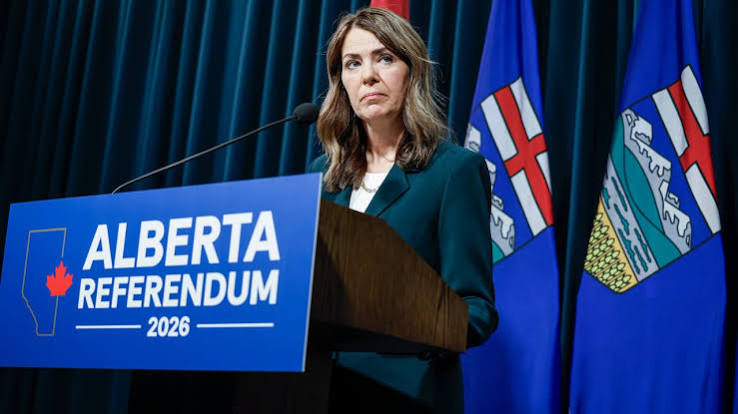
Edmonton: 10 Oct. 2026 Premier Danielle Smith is not an innocent bystander to Alberta separatism. Her government rewrote the rules, lowered the barriers and stripped away advance constitutional scrutiny, giving a fringe campaign a credible route to a province-wide vote. These were calculated acts of political enablement, and she must answer for their consequences. Bill 54, the Election Statutes Amendment Act, 2025, built the first section of that road. It cut the signature requirement for a citizen-initiated constitutional referendum from 20 per cent of eligible voters—roughly 600,000 people—to 10 per cent of the votes cast in the previous provincial election, about 177,000. It lengthened the collection period from 90 to 120 days and abolished the requirement for minimum support across two-thirds of Alberta’s ridings. Smith insisted, “You want a bar that’s high, but you don’t want a bar that’s impossible to achieve.” The bar she lowered was precisely the one separatists needed removed.1, 2 Bill 14, the Justice Statutes Amendment Act, 2025, cleared the next obstacle. After the Court of King’s Bench found a proposed independence question unconstitutional, the legislation prevented Elections Alberta—or anyone else—from obtaining advance judicial scrutiny of a proposed question before signatures were collected. It also restarted the process so the Alberta Prosperity Project could apply again immediately. Smith attacked such scrutiny as rule by “gatekeepers,” declaring: “Whether it’s the chief electoral officer or the court, they seem to want to approve the ones they like and hold up the ones they don’t like, and that’s not democracy.” But courts and electoral safeguards are not enemies of democracy. They defend the rule of law against the abuse of temporary majorities.3, 4
Her words reinforced what her legislation enabled. Smith promised that if citizens gathered enough signatures, an independence question “will be put forward.” She said some Albertans believed their grievances could not be addressed and had “lost hope in Canada.” Most revealingly, the Edmonton Journal reported her plea, “Don’t demonize them,” followed by: “I won’t say they are wrong, because they have got legitimate reason.” This was not merely a defence of civility. From a premier who had already dismantled barriers to a separation vote, it conferred legitimacy on a movement seeking to break up Canada. Her slogan— “I support an independent Alberta within a united Canada”—performed the same evasion: it borrowed the separatists’ language while denying where that language leads.2, 5, 6, 8
Alberta within a united Canada”—performed the same evasion: it borrowed the separatists’ language while denying where that language leads.2, 5, 6, 8 Smith’s private channel to Donald Trump deepened the concern. On January 11–12, 2025, while Trump threatened 25 per cent tariffs on Canadian goods, she met the president-elect at Mar-a-Lago and his golf club and called their exchange “friendly and constructive.” Photographs placed her beside Trump and Canadian businessman Kevin O’Leary, who had publicly advocated a Canada–United States economic union. A premier may defend provincial interests abroad. But as Canada confronted tariff threats and annexation rhetoric, Smith’s unilateral courtship of Trump— alongside an advocate of deeper U.S. integration—projected provincial self-interest where national solidarity was required.7 The charge is not that Smith openly calls herself a separatist; she says she would vote to keep Alberta in Canada. The charge is more serious: she made separatism easier to organize, harder to challenge and more respectable to defend. She lowered the threshold, curtailed scrutiny, validated the grievances and tolerated proseparation advocacy within her caucus. A premier cannot pave the runway, direct the aircraft toward takeoff and then claim no responsibility for the flight. Albertans should judge Smith by the machinery she created, not the reassurance she now offers. The democratic remedy is clear: relentless public scrutiny, legislative accountability and, if voters conclude that she put party survival and separatist pressure above Canada’s constitutional order, removal from office at the ballot box.
Notes: 1. Government of Alberta, Election Statutes Amendment Act, 2025 fact sheet. 2. Report quoting Smith on Bill 54, the reduced threshold, and allowing a citizen-led independence question. 3. CBC analysis of Bill 14 and the revived separatist petition. 4. CBC report quoting Smith on courts and “gatekeepers.” 5. Calgary Journal report quoting Smith on Albertans who had “lost hope in Canada.” 6. CBC report quoting “an independent Alberta within a united Canada.” 7. CBC News, “Alberta Premier Danielle Smith visits Donald Trump at Mar-a-Lago,” January 12, 2025; reporting the tariff threat, Smith’s description of the meeting, and the presence of Kevin O’Leary. 8. Edmonton Journal, June 6, 2026, reporting Danielle Smith’s remarks: “Don’t demonize them” and “I won’t say they are wrong, because they have got legitimate reason.”